
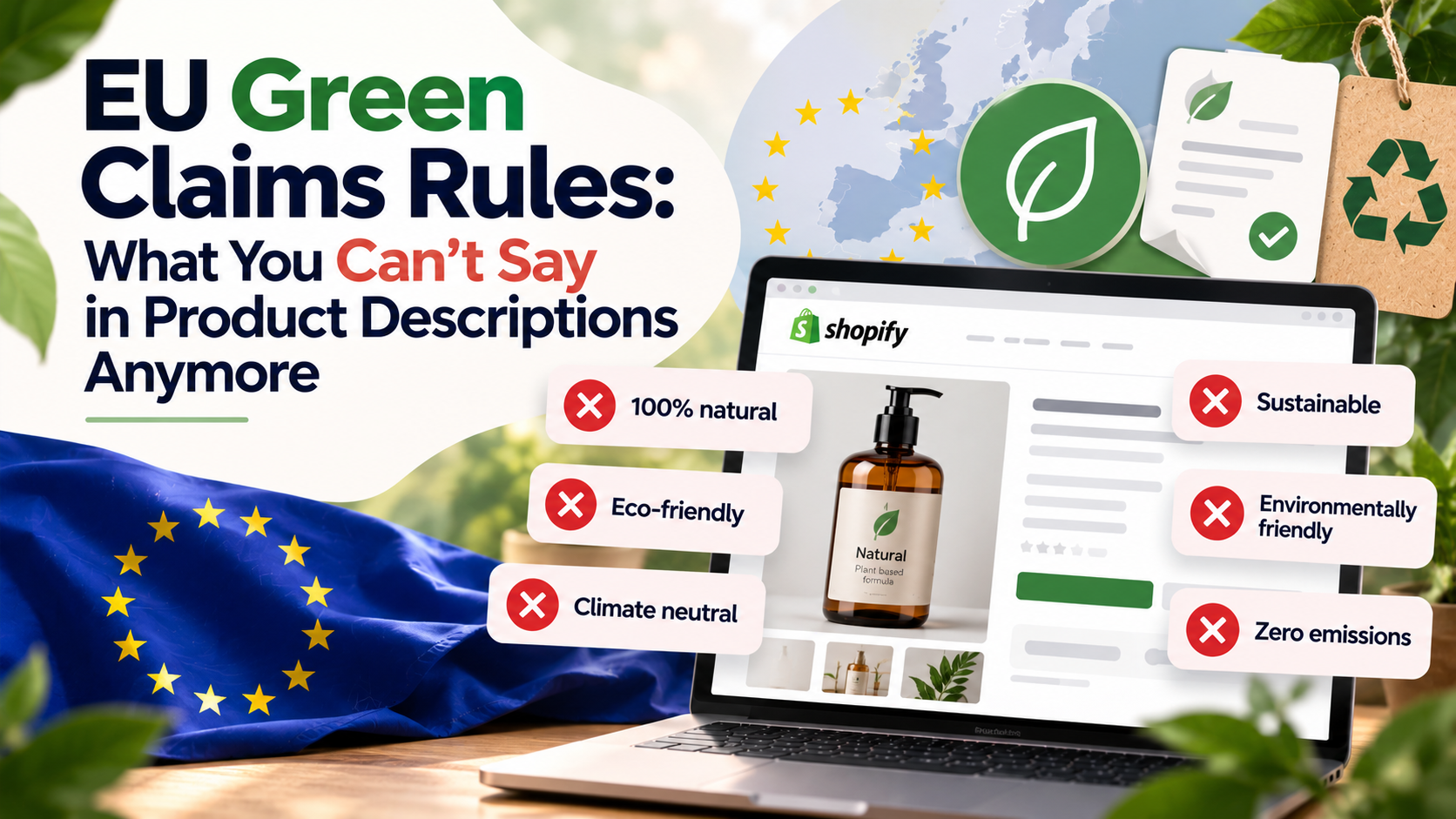
"Eco-friendly", "green", "sustainable", "climate neutral". These words are on thousands of product pages. Since 27 September 2026, many of them have become a legal risk when selling to EU consumers.
The change comes from the EU's Empowering Consumers for the Green Transition Directive (EU 2024/825). EU countries had to put it into national law by March 2026, and the new rules now apply. Here's what it means for your store's copy.
What's Now Banned
1. Generic environmental claims
Vague claims such as "eco-friendly", "environmentally friendly", "green", "nature's friend", "ecological" or "biodegradable" are banned unless you can show recognised excellent environmental performance relevant to the claim. In practice, that means an official EU Ecolabel or similar recognised scheme, not your own judgement.
2. Carbon neutral claims based on offsets
Claims that a product has a neutral, reduced or positive climate impact because you buy carbon offsets are banned. "Carbon neutral shipping" via offsets is a common example on Shopify stores.
3. Self-made sustainability labels
Sustainability badges and trust marks must be based on a certification scheme or set by public authorities. A homemade "Eco Choice" badge in your theme is no longer allowed.
4. Whole-product claims based on one feature
You can't present an environmental benefit as covering the whole product or brand when it only applies to one part. "Sustainable jacket" because the lining is recycled is a problem.
5. Misleading durability and repair claims
The directive also targets false claims about how long products last, and hiding information about features that limit durability.
What You Can Still Say
Specific, accurate and provable claims are still fine, and they're more convincing anyway. For example:
- "Made with 70% recycled polyester" (if you can prove it).
- "Packaging made from 100% recycled cardboard."
- "Certified by [real certification scheme]", with the certification shown properly.
- "Designed to be repaired: replacement parts available for 5 years" (if true).
The rule of thumb: specific, measurable and backed by evidence.
What About the Green Claims Directive?
You may have read about a separate, stricter "Green Claims Directive". The European Commission announced its withdrawal in June 2025. That does not change the rules above: the Empowering Consumers Directive is already law and is enforced through consumer protection authorities.
How to Audit Your Shopify Store
- Search your product descriptions for words like eco, green, sustainable, natural, carbon neutral, climate, planet and biodegradable. A bulk export makes this quick.
- Check badges and icons in your theme, collection pages and product templates.
- Review apps that add "carbon neutral shipping" or offset badges at checkout.
- Check marketing pages: About Us, sustainability pages and email templates.
- Replace vague claims with specific facts you can back up, or remove them.
- Store evidence: keep certificates and supplier data linked to products, ideally in metafields.
Frequently Asked Questions
Does this apply to UK stores?
It applies to sales to EU consumers. The UK has its own rules: the CMA's Green Claims Code, backed by new consumer law enforcement powers, already targets misleading green claims.
Can I still offset my shipping emissions?
Yes, you can offset. What you can't do is claim the product or delivery is "carbon neutral" because of it. You can describe what you actually do, accurately.
What about "natural" or "organic"?
"Organic" is regulated for food and some other products and needs certification. "Natural" can be misleading if not accurate. Be specific.
This article is general information, not legal advice.
Need product descriptions, badges and sustainability info updated across your Shopify store? I can bulk-audit and update product content and theme badges. Get a free quote.
Need a Shopify store built or improved?
Tell me what you need — I’ll respond within 24 hours with a realistic plan and quote.