
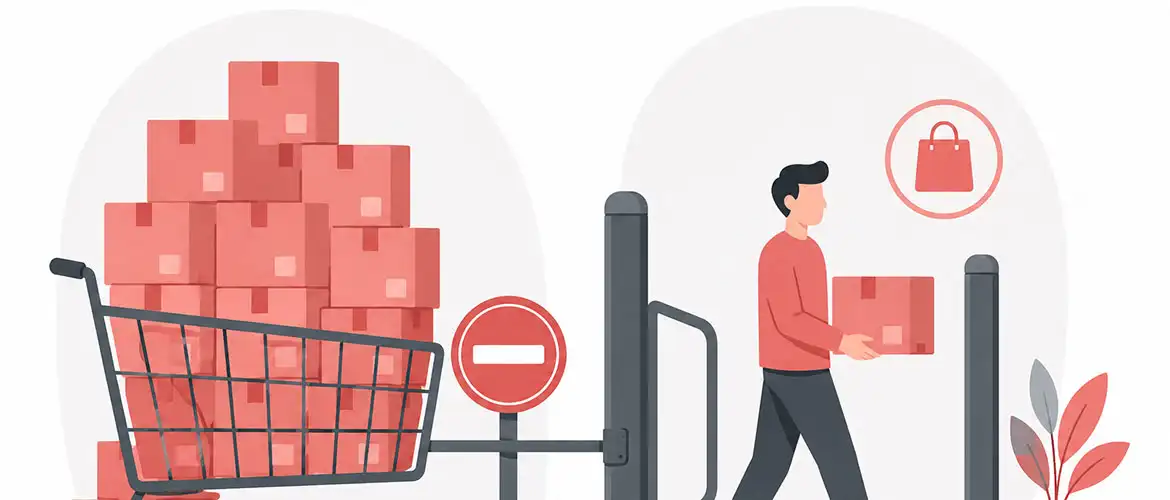
What Bulk-Buy Abuse Actually Looks Like
- Resellers buying entire limited drops: A handful of accounts purchase the majority of available stock, then relist at a markup elsewhere.
- Discount stacking through bulk quantity: Customers exploit a percentage-off or bundle deal by ordering far more units than the promotion was designed for.
- Bot-driven checkout speed: Automated scripts complete checkout faster than any human, clearing stock before genuine customers can act.
- Wholesale customers ordering through retail channels: Buyers placing wholesale-sized orders at retail pricing because no quantity cap exists on the retail storefront.
Why This Costs You More Than Lost Inventory
Beyond the immediate stock loss, bulk-buy abuse damages customer trust — shoppers who see a "sold out in 90 seconds" product, then see it relisted elsewhere at double the price, are less likely to trust your next drop. It also distorts your sales data, making a product look more successful than it actually was with your real customer base.
How Purchase Limits Solve This
A maximum quantity rule — whether per order, per customer, or per time window — caps how much any single buyer can purchase, regardless of how fast their checkout is. The most effective setups combine a few approaches:
- Per-customer maximums: Cap units per customer account, not just per order, since a single buyer placing multiple smaller orders can otherwise bypass a per-order cap.
- Tag-based exceptions: Let verified wholesale or VIP accounts order higher quantities while capping general retail traffic.
- Time-windowed limits: For repeat-drop products, limit purchases within a rolling time window rather than a single transaction.
- Clear customer messaging: Explain the limit at the point it's triggered, so legitimate customers understand it's intentional, not a glitch.
What Purchase Limits Won't Fix on Their Own
Quantity limits address bulk-buy abuse but won't stop bot traffic entirely on their own — that typically also requires checkout speed throttling, CAPTCHA, or a queue system for high-demand launches. Limits are most effective as one layer of a broader anti-abuse strategy, not a complete solution by themselves.
FAQ
Will purchase limits annoy legitimate customers?
Rarely, if the limit is set above what a typical real customer would order and explained clearly when triggered — most shoppers don't notice a limit unless they're trying to buy in bulk.
Can purchase limits stop bots completely?
Not entirely on their own. Limits stop bots from buying more than their cap, but a queue system or checkout throttling is usually needed to address bot speed advantages during high-demand launches.
Should purchase limits apply storewide or per product?
Per product or per collection is usually more effective, since abuse risk is rarely uniform across an entire catalog — apply tighter limits to your highest-demand, most limited items.
Limitly lets Shopify merchants set per-customer, per-product, and time-windowed purchase limits through a simple rule builder. Get in touch if you're planning a limited drop and want to protect it from bulk-buy abuse.
Ready to redesign?
Free 20-min consultation. Custom WordPress redesigns $750–$1,500. Training included. 7–14 day delivery.